From Theory to Practice: My Journey into Electrical Power System Design
 Monisha s
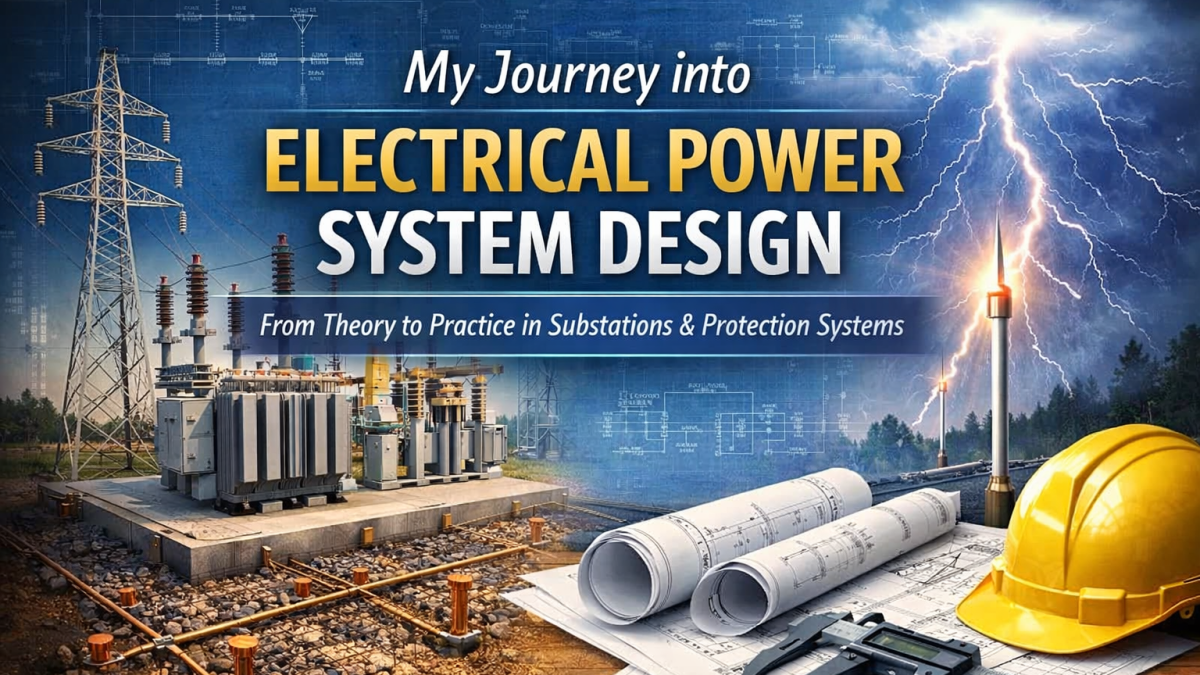
A hands-on learning journey in electrical design, exploring substations, grounding, drawings, DC systems, and lightning protection concepts.
A BLOG OF MY LEARNINGS IN ELECTRICAL POWER SYSTEM DESIGN
CONTINUOUS LEARNING IS AN ESSENTIAL PART OF EVERY ENGINEER’S JOURNEY
Last few weeks was a really interesting learning period for me as I spent time understanding several practical aspects of electrical power system design. Instead of focusing only on theory, the learning was more about how these concepts are actually used in real engineering projects.
One of the first things I worked on was understanding how to read engineering drawings properly. Initially, when we look at a drawing, it may just appear as a collection of lines, symbols, and dimensions. But as I started going through sample drawings and observing them carefully, I realized that every symbol and note has a specific meaning. Learning how to interpret legends, equipment symbols, and connection paths helped me understand how engineers communicate complete system designs through drawings.
Another topic I spent time learning was substation equipment layout. A substation contains several important components such as transformers, circuit breakers, isolators, busbars, current transformers (CTs), and voltage transformers (VTs). Understanding how these components are arranged in a layout helped me see how electrical power flows through different stages of the system. I also learned that equipment placement is not random; it must follow safety clearances, accessibility for maintenance, and proper operational requirements.
I also explored the importance of grounding and earthing systems in electrical installations. Grounding plays a crucial role in protecting both equipment and people by safely directing fault currents into the earth. I learned about different grounding approaches, including GI grounding pits and copper grounding pits, and how they are selected depending on the design requirements and site conditions.
Another area I looked into was DC power systems used in substations. These systems are essential for operating protection relays, control circuits, alarms, and communication equipment. Even if the main AC supply fails, the DC system ensures that critical protection and control functions continue to operate reliably.
One of the most interesting topics I started learning about was lightning protection systems. Lightning can cause severe damage to electrical infrastructure, so proper protection methods are very important. I studied two common protection approaches: the Protection Angle Method and the Mesh Method. These methods help determine how lightning protection systems such as air terminals and conductors should be arranged so that the entire structure remains within a protected zone.
Along with that, I also began exploring the basics of lightning protection risk assessment. I learned that before designing a lightning protection system, engineers first perform a risk assessment calculation. This process involves collecting various inputs such as building dimensions, structure type, lightning ground flash density of the area, and the potential impact of lightning strikes. These inputs are then used to evaluate the level of risk and determine whether lightning protection is required and what level of protection should be provided.
I also touched upon some basic concepts related to cable sizing and power system studies, which are important when designing electrical systems that need to safely carry load currents while also withstanding fault conditions.
Overall, it was a valuable learning experience for me. From understanding how to read engineering drawings to exploring substation layouts, grounding systems, and the fundamentals of lightning protection design, each topic added a new perspective to my understanding of electrical power systems.
There is still a lot more to learn, but experiences like this make the learning process both practical and exciting. Step by step, it is helping me to build a stronger foundation in electrical power system design.
“ ELECTRICAL DESIGN IS A CONTINUOUS LEARNING JOURNEY AND EVERY NEW COCEPT BRINGS US ONE STEP CLOSER TO BECOMING BETTER DESIGNER AND PROBLEM SOLVER”
Categories: : Career Growth, Earthing Design, Electrical Design & Engineering, IEC Standards, Power System Analysis, Technical Training & Certification, Transformer Sizing